
Fleet & Commercial Detailing for Binghamton Area Companies

Company vehicles cleaned at your own yard, on a repeating schedule, by a crew carrying equipment bought specifically for fleet work.

Start a Fleet Conversation

Vans, service trucks, pickups and company cars in one visit

Worked at your lot on a bi-weekly or monthly cycle, with no vehicle leaving the site

Fully insured
4.9 across 50+ Google reviews
We come to your yard
Monday to Saturday, 8 AM to 5 PM

Whose Job Is It to Keep the Fleet Clean?

The vehicle is the first thing your customer sees

Most people asking about fleet detailing are not car enthusiasts, they are the person who noticed that the company van pulling into a customer's driveway is carrying two weeks of road salt and a windshield nobody has touched since the last storm. That van does the introducing before anyone knocks on the door, and a Broome County winter is unkind to a first impression. Clean glass also has a straightforward safety argument behind it, which is why OSHA's motor vehicle safety guidance treats vehicle condition as part of a working safety program rather than a cosmetic concern.

Nobody on payroll has time to run vehicles through a wash

The usual fix is to hand a driver twenty dollars and a lunch hour, and it fails in a predictable way, because a tunnel wash never touches the cab. The cupholders keep the coffee rings, the door seals keep the grit, the floorboards keep whatever the last job tracked in, and the exterior comes back streaked from a wet towel. You are paying a technician's hourly rate to sit in a wash line and still getting a vehicle that looks handled rather than maintained.

A detailer who cancels on a fleet costs you twice

Reliability is the part of this you actually care about, and it is the part most detailers are worst at. A missed visit is not just a dirty van, it moves a whole schedule and it puts the coordination back on your desk, which is the job you were trying to hand off. Federal maintenance and inspection rules already give operators enough to track without a vendor adding to the pile, so dependability is what we sell first and thoroughness second.

How a Fleet Visit Runs at Your Own Lot

Why most fleet detailers want your vehicles dropped off

A shop needs your vehicle to come to it, which is a fine model for a personal car and a poor one for a fleet, since every vehicle you send across town is a vehicle that is not working and a driver who is not driving. We built the business the other way around: the crew, the water, the power and the chemicals all travel, so the vehicles stay where they are and the day stays intact.

We work at your yard, and no vehicle leaves it

Everything happens on your property. We set up in the spot you point at, work through the vehicles in whatever order suits your schedule, and pack out when the last one is done, so nothing gets driven off site, nothing gets left overnight somewhere else, and nobody on your team has to arrange a shuttle. If a vehicle is needed mid-visit, we pull it forward in the order rather than holding it.

Repeating schedules, set around your slowest day

Commercial work runs on a repeating cycle rather than a phone call every few weeks, and that is what makes it work for both sides. We maintain company fleets on repeating schedules across Broome County, some on a bi-weekly cycle and some monthly, usually built around the day of the week when the most vehicles are actually parked. The same idea at consumer scale is what our monthly maintenance plans do for a single vehicle: a maintained vehicle needs less deep work, so the visits get faster and the rate reflects that.

The Equipment We Bought Specifically for Fleet Work

Tornador Z-020 cleaning tool

A cone nozzle fed by a solution bottle that sprays a fine mist through an interior, so carpets, seats and the tight crevices get cleaned rather than wiped around. It reaches the places a cloth cannot, the vents and the cupholders in particular, and it holds quality steady across a run of ten vehicles instead of letting the last cab of the day come out worse than the first. It can cut labor time per interior, and it takes a real amount of fatigue off the crew, which matters more than it sounds when the same two people are working a full fleet in one visit.
A high-GPM pressure washer

The unit we run for fleet work is a Simpson 3000 PSI on a Honda GX200 engine at 3.0 gallons per minute. The number that matters there is the flow rate rather than the pressure, since moving more water per minute is what actually carries grime off a large panel, and on a mobile fleet job that can shorten the labor time on every vehicle in the line.

IK e Foam Pro 2 foamer

This is the foamer we bring out for the bigger vehicles. Because the tank is pressurized, nobody is standing there pumping a handle while the chemical goes on, and the tank capacity means fewer stops to refill, both of which pull minutes off the time we spend on your lot.

MTM Hydro 36-inch steel lance

An extension wand that attaches to the pressure washer gun and reaches the roof of a tall vehicle from the ground. A ladder does the same job eventually, but it has to be repositioned around the entire perimeter of every van, which is slow, and slow on a fleet is expensive for you rather than for us.

Ego Power Plus 765 blower

A strong battery blower that dries a vehicle with air instead of a towel that is already wet from the last one. Drying is faster, and the streaks that a saturated towel leaves behind on a dark panel do not show up in your parking lot two hours after we leave.

What This Equipment Buys You

Every item above buys the same thing, which is less on-site time per vehicle, and less on-site time per vehicle is the entire reason volume pricing works for both of us. A crew running consumer tools across a twelve-vehicle fleet either takes all day or cuts corners somewhere you will find later, so the only way to offer a fleet rate is to earn it back in efficiency rather than in shortcuts. It is also the practical difference between us and most crews you will find, since most of them are set up for one car in a driveway and a line of twelve is a different job. This equipment was bought for that, before there was a fleet page to write about it on.

A Whole Mix of Vehicles in One Visit

Vans and larger vehicles

Vans are the bulk of most local fleets and they are the reason the lance and the foamer are on the truck, because a tall flat panel and a roof you cannot reach are the two things that slow a crew down. Cargo areas get treated as part of the vehicle rather than as an optional extra, since a cargo floor that has been ignored for a year is usually where the smell in the cab is coming from.

Service trucks and pickups

Work trucks come in genuinely dirty, and that is fine, it is what they are for. Beds, wheel wells, running boards and the door jambs that everybody else skips all get worked, and the interiors get the same back-to-front order every other vehicle gets rather than a quick pass because it is a work truck. Commercial vehicle detailing in Binghamton mostly means work trucks, so this is the class the crew spends the most hours on. New York State commercial vehicle registration puts these on the road as business assets, and they tend to be the ones customers see closest up.

Sedans and company cars

The cars that carry your people to meetings get the same interior process as everything else, which is worth saying because sedans are usually the vehicles that get skipped in a mixed fleet. Mixed fleets are normal here, and a visit that covers a van, two service trucks and three sedans in one pass is a normal shape for a day. A company vehicle cleaning service that only handles one class of vehicle is not much use to a business running three.

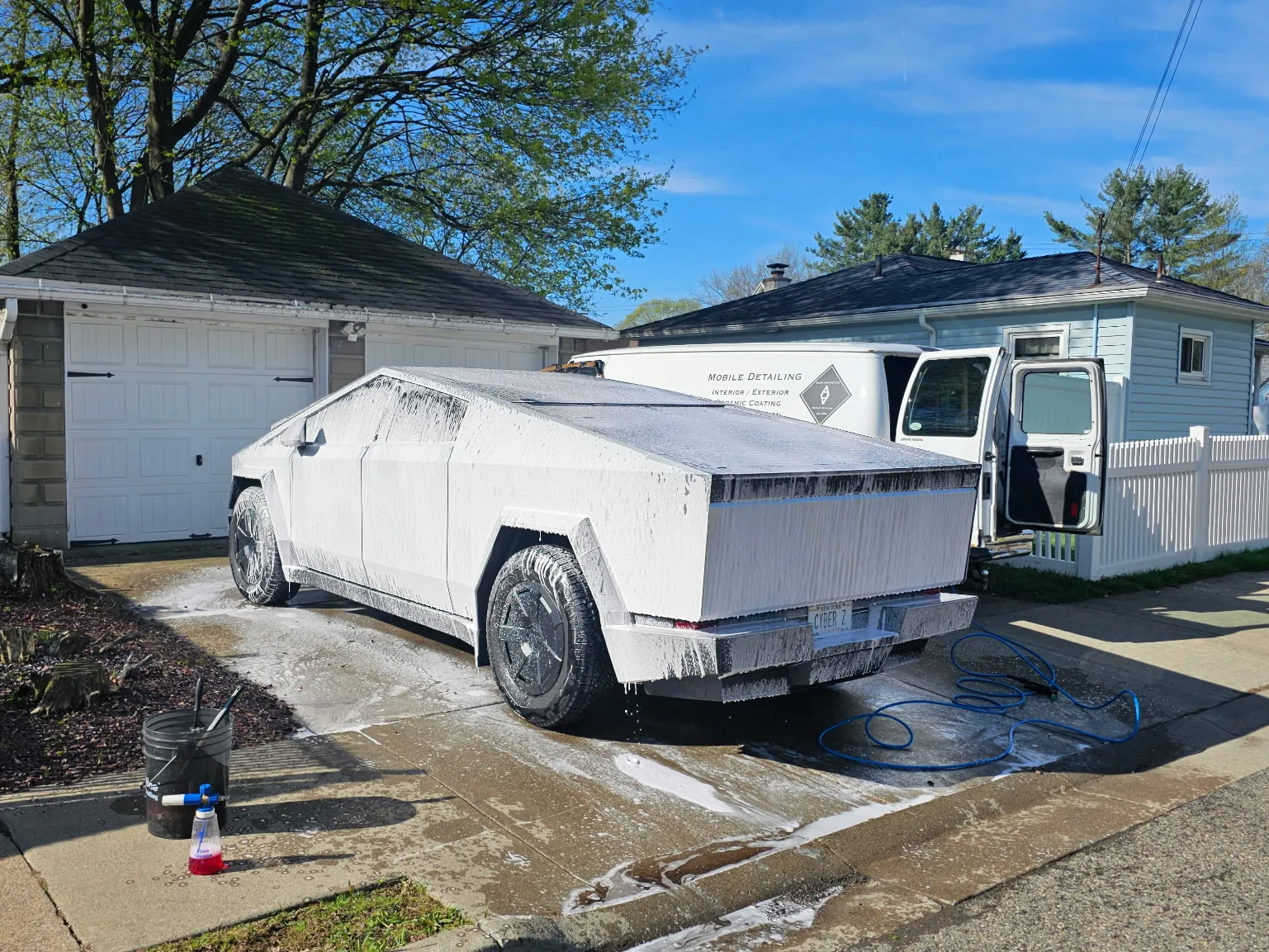
The Auto Aesthetics mobile detailing van servicing a vehicle on site during a fleet visit near Binghamton, NY

The wheel faces, the barrels and the lug nuts, on every vehicle in the line

Prices are unbeatable and the work is flawless, have had 3+ vehicles detailed within the last week or so and had a great experience with everyone of em! Excellent customer service and overall the best in town!

Kalid R.Google Review

Detailing as an Employee Perk, Run in Your Own Parking Lot

How a detailing day at the workplace works

We set up in your lot for a block of hours and employees bring their own vehicles out to us during the day, so nobody spends a Saturday morning on it and nobody drives anywhere. You decide the format: the company covers it outright as a benefit, or it subsidizes part of it and the employee covers the rest, or employees simply get access to on-site booking at a set rate. We handle the scheduling so it does not turn into somebody's side project.

Why employers ask for it

It is a benefit people actually use, which is more than most perks manage, and it lands as personal rather than administrative because the employee drives home in a car that looks cared for. Nobody else around here offers it, so it means something rather than reading as a repackaged discount, and for an employer weighing retention spend it can be a visible, low-friction option.

Pairing the perk day with your regular fleet visit

The efficient version is to run the perk day on the same visit as the fleet cycle, since the equipment is already deployed and the setup cost is already spent. Company vehicles get worked first thing, employee vehicles run through the middle of the day, and everything wraps in one mobilization instead of two.

Where We Focus, and What We Turn Down

We do not take dealership accounts

Dealership work is a deliberate no for us. It is a real business and other detailers build good operations around it, but the volume-per-unit model it runs on pulls in the opposite direction from the way we work, and taking it on would change what a commercial account gets from us. Turning it down is what keeps the schedule open for the fleets we do serve.

We do not take vehicles with mold or biohazard contamination

Those need specialized remediation rather than detailing, and sending a detailer at that problem does not solve it. If a vehicle in your fleet has gone that way, tell us and we will say so plainly instead of quoting it.

What a Fleet Quote Depends On

How many vehicles

Count is the first thing we ask, because it sets whether a visit is a half day or a full one and whether the schedule makes sense as bi-weekly or monthly. Volume is the other lever on rate: more vehicles in one mobilization means the setup cost is spread across more work, which is the part that lets a fleet rate sit below what those same vehicles would cost booked one at a time.

What class they are

A sedan, a pickup and a tall cargo van are three different amounts of work, so a quote built on a flat per-vehicle number is a quote that is wrong for most of your fleet. We price the mix you actually run.

What condition they are in

Condition is the variable that surprises people, since the first visit on a fleet that has not been maintained is always the heaviest one, and the visits after that are lighter because the buildup never comes back. It is worth quoting the first pass and the recurring cycle separately so you can see the difference rather than being averaged into a number that hides it.

How often you want us

Frequency is yours to set, and it changes the rate meaningfully. If you want a straight answer on what your fleet would run, the fastest path is a short conversation about those four things, and we will come back with a number rather than a range.

Fleet and Commercial Detailing Questions

Do you detail company fleets?

Yes, and it is the part of the business we are actively growing. We maintain company fleets on repeating schedules across Binghamton, Endicott, Vestal, Johnson City, Windsor and Owego, and if your vehicles are anywhere in that area, we are already nearby.

Do you come to our yard, or do we have to bring the vehicles to you?

We come to you. The crew, the water, the power and the chemicals all travel, so the work happens on your property and no vehicle leaves the lot. You point at a spot, we set up there, and we pack out when the last vehicle is done.

How often do you service a fleet?

Whatever cycle keeps the vehicles where you want them, which in practice is usually bi-weekly or monthly. Bi-weekly holds a consistently presentable standard, monthly costs less per year and lets more buildup return between visits, and we will tell you which one your fleet needs rather than selling you the frequent one by default.

What does fleet detailing cost?

It depends on four things, and any detailer who quotes a fleet without asking them is guessing: how many vehicles you run, what class they are (a sedan, a pickup and a tall cargo van are three different amounts of work), what condition they are currently in, and how often you want us on site. The first visit on a neglected fleet is always the heaviest, and the recurring visits after it are lighter and cheaper, so we quote those two things separately instead of averaging them into one number that hides the difference. We do not publish a fleet rate because a published number would be wrong for almost every fleet that reads it. Send us the vehicle count and the mix and you will get your number.

Can you detail employees' personal vehicles as a workplace perk?

Yes, and it is one of the few things in this market nobody else offers. We set up in your parking lot for a block of hours and employees bring their own vehicles out during the working day. The company can cover it outright, subsidize part of it, or simply arrange the access, and it pairs efficiently with your regular fleet visit because the equipment is already on site.

Are you insured?

Yes, fully insured, and we can confirm that directly for your records before the first visit.

Start the Fleet Conversation

What happens after you reach out

You get a real conversation rather than a form response, and it is short. We ask about the vehicle count, the mix, the condition and the frequency you have in mind, and then we come back with a number and a proposed schedule. If your yard is inside the core Broome County area we can usually look at the fleet in person before quoting it.

Start a Fleet Conversation

What we will ask you for

Three things: how many vehicles and what they are, where they sit during the day, and which day of the week most of them are parked. That is enough to build a schedule that fits your operation instead of ours. Call (607) 341-0037 or send it over and we will take it from there.

Call (607) 341-0037